
Sharing a Moment of Certainty About Grace.
September 24, 2026
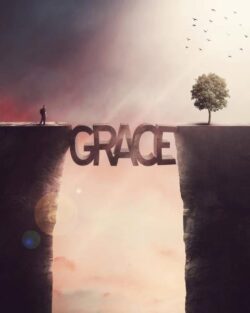 “If you can’t see what you’re looking for, see what is already there.” This idea popped into my head when I was asking for help with a little overwhelm and confusion about something I wanted to happen a certain way… it wasn’t going well and I had a niggling worry that I was going to lose out on something important.
That phrase was followed by this thought: “It’s hard, faced with potential loss of a treasured idea or dream, to see that we live and breath in abundance in every moment and it’s hard when in difficulty or pain to feel that all we need surrounds us and is within us without ceasing.”
Isn’t that soOoo true? The truth is, we are swimming in grace in every single moment.
Such a simple concept but not one easy to remember and to live as our constant reality.
“We are ‘swimming’ in grace.” I’ve been thinking about the miracle of this… that even when dark and flattened out by trial or change or loss, we can still reach out and touch it by simply acknowledging aloud that we know it is there, close, along the shimmer of every horizon. I’m shocked by how often this small vocal acknowledgement brings that horizon so close.
Today I feel certain of it. I don’t always feel it so surely, but today I do, so I wanted to pass that assurance on to you. Feel free to pass grace along any time you notice how embraced by it you are too.
Along with much love,
💗 Mayet
Khalil Gibran’s Prose-Poem on Joy. And Sorrow.
September 17, 2026
 Do you remember seeing the following piece on joy and sorrow in the book, The Prophet? That was the first alternative spiritual material that made it’s way to me…when I was 15, I think I’ve mentioned this before here. You likely have read and enjoyed the book along your path too.
I’ve chosen to share it today because I’m always fascinated by cultures that more readily accept the states that westerners—especially perhaps western spiritual people—judge and/or are trying to escape, such as despair, grief, sadness, or in this case, sorrow.
It’s quite Persian to see sorrow as simply part of being alive, rather than a reason for leaving. But in our culture—and certainly my own inner culture—we’re always waiting for these to get over and done with so we can get back to the good stuff.
It’s always seemed to me our preference or determination around being consistently “up” is at least slightly addictive. I even think it might correlate to our tendency to consume all our resources—personal or otherwise—and to having as our prominent diseases ones, such as cancer, that consume the host. This constant appetite for being “on” and being “up” doesn’t strike me as a natural rhythm and I think life certainly reveals that to us.
However, I readily admit that I don’t find it easy to sit still for sadness nor to be patient with feeling down, nor very accepting of sorrow. In my head I totally get that these are all important parts of living, of being here… that they are necessary for the development of our own humanity. But I find places in me—being so western bred—that are absolutely unwilling to accept this.
In those place I want to believe that life doesn’t need to have struggle in it or difficulty. I feel responsible if it does, or if things don’t feel good. I always seem to carry at least a smidge of inner conflict about that. And sometimes it’s more than a smidge of that resistance. But perhaps the latent resistance helps me not to wallow too long or may keep me from sinking into self-pity, which is such a downward spiral toward lasting depression.
But here, Khalil Gibran beautifully brings the ups and the downs, the lights and the darks of life together in peaceful harmony. Reading it always soothes this conflict in me. It is so true, for instance, that if a broken heart is my particular sorrow, it is love that has been my joy. And if companionship is my joy, then it is death with it’s various partings that will become my sorrow. Things are not linear nor are they even a spectrum, they are always a whole, as he points out.
To your day, and to your many joys and sorrows,
XO Mayet
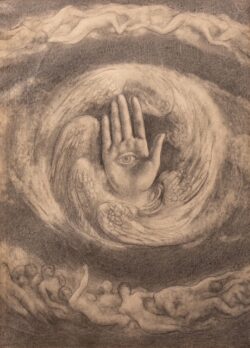
PS—He was also an artist and the illustration today is one of his drawings, titled “Vision”.
On Joy and Sorrow
By Khalil Gibran
Your joy is your sorrow unmasked.
And the selfsame well from which your laughter rises was oftentimes filled with your tears.
And how else can it be?
The deeper that sorrow carves into your being, the more joy you can contain.
Is not the cup that holds your wine the very cup that was burned in the potter’s oven?
And is not the lute that soothes your spirit, the very wood that was hollowed with knives?
When you are joyous, look deep into your heart and you shall find it is only that which has given you sorrow that is giving you joy.
When you are sorrowful look again in your heart, and you shall see that in truth you are weeping for that which has been your delight.
Some of you say, “Joy is greater than sorrow,” and others say, “Nay, sorrow is the greater.”
But I say unto you, they are inseparable.
Together they come, and when one sits, alone with you at your board, remember that the other is asleep upon your bed.
Verily you are suspended like scales between your sorrow and your joy.
Only when you are empty are you at standstill and balanced.
When the treasure-keeper lifts you to weigh his gold and his silver, needs must your joy or your sorrow rise or fall.
The Mischievous Crow
September 10, 2026
 I came across this playful little poem today and thought it fun to offer as a nice lift for your day. It made me smile, and the idea of snow this time of year felt cooling, which is nice. Then, very serendipitously I came across the art piece pictured which seems so much like the moment in the poem… the crow mischievously overlooking his prankster fool’s deed… it offered me a second smile, and I’m sure you too. 😊
XOXO Mayet
Dust Of Snow
The way a crow
Shook down on me
The dust of snow
From a hemlock tree
Has given my heart
A change of mood
And saved some part
Of a day I had rued.
~ Robert Frost