
My Life’s Changing, How About Yours?
August 29, 2024
Article highlights:
- Big changes in my life
- The need to reinvent yourself and/or your life
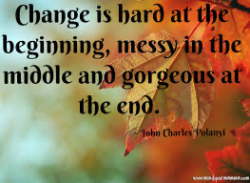 There are some big changes going on in my life, how about yours? I’ll be talking more about my changes in the next weeks but for today I wanted to say something about this more generally.
It seems to be a time of change not only for me but for many I know and hear from. Divorce, marriage, moving, jobs ending, jobs starting, new babies, loss of friends and family, health challenges, new projects… it’s the relatively bigger life-stuff.
For instance, my work is changing and I’m not yet sure exactly what my new work picture will be. But I’m in a reinvention for sure. Many of us find ourselves needing – or wanting – to reinvent ourselves and our lives right now.
So here’s the thing about big changes and reinventions. There’s ALWAYS a lot of unknown within that, which means there’s no road map. Because we first have to get a sense of the new landscape and gain a clearer understanding about where we are headed within it. Which is a discovery process.
That means a lot of questioning, planning, responding, deciding. That’s stressful. Unavoidably stressful. AND we can find ourselves drowning in details, details, details. In such periods, overwhelm is ever-present. You know what I’m talking about right?
I’m not going to belabor this today; I just wanted to mention it’s happening for a lot of us, maybe you too.
How to get through it with the very best outcome? Well, I’m getting a lot of messages from my life about one thing that’s needed. AND it’s not something people such as ourselves necessarily agree with, or want to hear.
Yesterday I got the message again in the form of a quote from Elizabeth Gilbert – author of Eat, Pray, Love. It came as an indirect answer to my question about how to proceed when I’d been overwhelmed by all the details of change. Here’s what she said:
“You have to participate relentlessly in the manifestations of your blessings.”
Yes, manifestation takes considerable action and application. We new agers sometimes give up too easily. Some of you lucky few have fistfuls of determination, unlimited energy, and love being challenged. The rest of us want things to be easy, to “manifest” without much effort.
I think we’ve been taught a lot of silly stuff that’s even caused us to think we’re spiritual failures if things aren’t easy. We take it as a sign and give up. We struggle with this.
Rebirth is what it is. There’s a lot of compression and pressure in the birth-canal. It’s not all that easy getting born… or reborn. Or birthing a new project or phase of life.
It’s being suggested to me that we need to face up to this, step up, and “participate relentlessly in the manifestations” of our own blessings.
That’s the message I’m getting. So I’m sucking it up and getting on with it whether I feel like it or not. And often I don’t feel like it, but I’m doing it anyway, no matter the resistance I feel.
Doing that – funnily enough – I’m finding that things are getting a little easier. Isn’t THAT interesting? It takes sweat and focus to pave Easy Street, apparently.
That’s my bit of musing for this week. Feel free to let me know how it’s going for you…
With renewed determination and action,
Mayet
What Does Gaia Think?
August 22, 2024
 Article highlights:
-
-
-
-
-
-
- My thoughts on this picture
- What are yours?
-
-
-
-
-
Heart of Love Message: Which Side Is Right?
August 15, 2024
 Article Highlights:
 -
-
-
-
-
-
- Which candidate (etc) is right?
- Divide and conquer
-
Heart of Love guidance
-
-
-
-
-
Which side is right? According to Spirit, that’s apparently not the question. This dissension is nothing more than the old Divide and Conquer strategy. It not only separates us from one another – something precious to lose – but it separates us from the mind of that which is God. Something far too precious to relinquish. Today I’m sharing a Heart of Love Message about that.
Three or four elections ago Wisdom gave me this guidance about politics and “sides” in general:
A Message From the Heart of Love
Which Side is Right?
“In your specific times, if one has chosen a side (politically) then one is automatically manipulated and therefore more at risk. Because Divide and Conquer is the overall plan of those who wish to control earth’s outcome for their own non-inclusive agendas.
So do the best you can in deciding about each election or issue, but know that – as has always been the case – so called conspiracies abound on both sides. No side has complete integrity in these times. However, do not therefore throw up your hands in defeat, do your best to chose wisely and to support the fostering of what is good for the world.
But don’t get lost in the issues. Or over-identified with sides. Or join the hating and finger-pointing. If you do, you will likely either become dragged down by despair or become riled in a way that causes you to be a frequency match for “them.”
Know that, tho these are important times, they do not hinge on one election of any one country. They hinge on you and your light. It’s what you came for, not to become embroiled in political drama and strenuous divisiveness with those on “the other side” of any one issue.
Your clear and simple task is to do what you can about an issue BUT also add higher perspectives to your thinking, instead of the perspectives of the lower divisiveness.
Remember that, above all, your primary task is to hold steady. To stay balanced in yourself at all costs, returning to balance again and again as necessary. BE what is needed now… AN ANCHOR OF LIGHT.
This doesn’t include side-taking or faltering and wobbling with statements and questions based in fear. It does NOT include participating in all the drama going on currently. It doesn’t mean hoping for the worst, or fearing the worst.
What it means is BEING the light you actually are, that’s your simple, clear task.
You do not want to return to your spiritual home and see that while on earth you got caught up in the drama, forgetting what you came for.”
~*~*~*~*~*~*~
Learning to be at peace with widely divergent opinions and even great injustice – while still doing what you can and being who you really are – that’s not for the faint hearted, is it?
Sending you blessings and hugs right now,
Much love,
Mayet Leilani