
September 4 , 2025
Article highlights:
- Ho’oponopono defined
- 7 principles of ho’oponopono
- A healing pono prayer
 I first visited Hawai‘i on a 30-day solo pilgrimage to mark my 30th birthday. I traveled across the various islands, and one day on a beautiful, somewhat remote beach on Maui, I met a Hawaiian elder and her grown nephew. She was instructing him in Hawaiian ways, and as we visited, she welcomed me into their conversation about healing.
That afternoon, she — “Auntie,” as she asked me to call her — spoke with us in depth about our conflicts with family members, leading us each toward honest self-assessment and the releasing of painful memories so we wouldn’t carry those heavy burdens anymore. Then she gave both her nephew and me a healing blessing. She chanted in Hawaiian and sprinkled us with ocean water from a frond she dipped in the waves.
I felt an overwhelming rush of loving energy stream into my heart, my whole body warming, tears welling in my eyes. Then Auntie walked quietly down the beach, leaving us to sit in silence, letting the prayer “be with us.” Before we parted, she placed a flower from her hair and a shell into my hands. I have treasured the little shell these many years.
That was my first introduction to ho‘oponopono, a series of teachings and practices for “setting things right” in yourself and with others. The word seemed mysterious then, yet it spoke to me deeply. Looking back, I realize how privileged I was to be included in what was one small part of a tradition of restoration for living in balance, one that has been preserved within Hawaiian tradition since ancient times.
Over the years, through conversations with elders and kahunas during extended stays in Hawai‘i, I have sought to better understand this wisdom of reconciliation — how we heal rifts, restore relationships, and return to wholeness. What I’ve learned so far is what I wish to share in part here.
Let me be clear: I am not a ho’oponopono kumu (teacher). I have not been formally trained, nor do I have the depth of knowledge about it that exists in the culture. What I offer is only what I have gleaned in hopes of gaining some benefit while honoring this tradition and not adding to the misunderstandings that surround it.
So — what is ho‘oponopono?
It is not, in fact, the forgiveness practice popularized in the West — the version that repeats the four phrases: “I’m sorry. Please forgive me. Thank you. I love you.“ While this has offered benefit to many, it is not ho‘oponopono. It can certainly be used effectively but should not be called ho‘oponopono. It is a forgiveness practice.
Forgiveness may be a part of the teaching, but it is not its focus. The true purpose of ho‘oponopono is always reconciliation. It seeks to achieve the peaceful resolution of conflict, and the restoration of balance between people. Traditionally, a trained kumu (master teacher) leads the process, guiding participants through specific teachings, prayers, and rituals that help uncover truth and restore harmony.
The word ho‘oponopono roughly translates as “to make right” or “to return to balance.” The process allows participants to release burdens — called pōhaku, or stones — so healing can occur. Central to the practice are self-honesty, humility, and other such values deeply rooted in Hawaiian culture. Historically, it has always been communal, between willing family or community members. It leads to learning to live together in better ways.
At its heart is the root word pono. Pono can be defined as goodness or harmony but it is more than this. Pono is a way of life. One learns to live pono. Living pono is a commitment to act with integrity, fairness, and respect, even when no one is watching. To “live pono” is to choose what is just and beneficial for both the individual and community.
Children in earlier times were taught these principles from birth — how to live in balance, how to restore harmony when things went awry, how to walk in the world with integrity. Imagine being raised in such a culture. What a gift of wisdom it would be to be immersed in this from the start.
Ho‘oponopono is often described as “setting one’s house in order” so that harmony can be restored. Through it, each person learns deep self-honesty, humility in conflict, and awareness of how one’s actions affect others. Ultimately, each participant agrees that, whatever has gone before, they will take full responsibility for preserving relationships going forward — by living pono.
To me, ho‘oponopono is also about restoring and supporting the frequency of reconciliation in our lives and world; even the word carries that frequency.
My goodness, how we need this just now, right? To help us integrate the frequency of reconciliation in our own lives and world, I’ve pulled together the ho‘oponopono principles I’ve gleaned so far as being important to becoming reconciled with others.
Keep in mind these are not the only core principles of ho‘oponopono, only the ones I have learned over time. Ho‘oponopono itself is a layering of teachings, rituals, and ceremonies specific to Hawaiian culture.
Core Principles
- Reconciliation — the true aim of ho‘oponopono is not forgiveness alone but the restoration of harmony and right relationship.
- Release of Burdens (pōhaku) — letting go of what weighs down the heart, so healing can move freely.
- Truthful Self-Assessment — becoming deeply self-honest, humble, and aware of one’s actions and their impact on others.
- Taking Responsibility — each person choosing to carry responsibility for maintaining relationships going forward.
- Living Pono — embodying integrity, fairness, and balance as a way of life, not just a momentary practice.
- Communal Healing — recognizing that this healing is not solitary; it is about restoring the health of relationships in families and communities.
- Sacred Guidance — honoring the role of elders, prayers, and ceremony in helping people move toward wholeness.
A Prayerful Affirmation in the Spirit of Ho‘oponopono
Here is a short prayer-like affirmation drawn from the principles above. It can be spoken inwardly, or aloud, as a way of aligning with the heart of ho‘oponopono:
A Prayer of Reconciliation
May I forgive and release the burdens I carry.
May I let go of all that weighs my heart down.
May I feel reconciled with those I have hurt or who have hurt me.
May I see myself truthfully, but with compassion and humility.
May I, going forward, take total responsibility for my actions and their effects on my life and others.
May the ancestors and wisdom-carriers guide me and light my way.
May I live “pono” — with honesty, integrity, balance, and care for others.
May harmony be restored within me, among us, and between us.
Perhaps there is nothing more important to support in our lives, and in our country, right now than the frequency of reconciliation, right?
May we take inspiration from this teaching. May we seek in our own hearts how the spirit of ho‘oponopono might guide us toward greater balance and reconciliation in our own relationships. That is my prayer.
I’m sending you love today,
Mayet Leilani
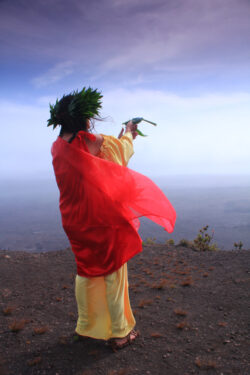
CREDIT — The wonderful photo is by Robert Frutos and is of Kalei I‘iliahu, who was a dear friend to us both. May the ancestors bless you on your journey in spirit, dear one.
