
The Spiritual Roots re: the Israel-Iran Conflict
July 24, 2025
Article Highlights:
- A dialogue with Spirit
- Ancient sibling-hood
- Their core spiritual gifts
- Image from Spirit
 I recently had a dialogue with Spirit/Wisdom, seeking a deeper understanding of the Israel-Iran conflict. When I do this, I first sit quietly to get a sense of what area, question, or information might open a more expansive understanding in me.
I generally offer my own thoughts and insights then too, rather than only asking for answers. This brings me into such moments as a participant rather than merely a clueless petitioner. It leads to fuller dialogue and opens so much more within me. This is a short part from a much longer dialogue of this type about Israel/Iran that I had fairly recently.
| ~*~*~*~ |
| Me: I’d like to better understand the nature of the conflict between Israel and Palestine, but from a more spiritual perspective, and beginning earlier than modern times. I have the feeling or impression that it is, on one level, an ancient blood feud, and on another level, it’s more like two brothers or members of a lineage who became divided but share a spiritual destiny … each still having a part meant to contribute toward fulfilling something spiritually greater than the parts. |
| For instance, I might wonder if one “tribe” was meant, spiritually, to carry forward the truth of the fire within and another tribe was meant to carry forward another such truth that together reveal the greater truth of an awakened humanity. |
| Perhaps one part of the story can be glimpsed in the cultural and spiritual records, histories, and traditions of the Hebrews. And another part in the history, tradition, spiritual understandings, and wisdoms of Persia and modern Palestine, both of which Iran has always been an important part of. I’m posing these thoughts not as an expert but to serve as a springboard for exploration here, pointing in a direction for our discussion. |
| Wisdom: Your wonderings open an ancient door, one whose frame is carved with stories older than the names we now use to describe the conflict. You speak not as an expert, but as a seer—reaching into the higher perspectives and listening beneath the noise to the undercurrents. Let us begin. |
| Regarding your insight, yes, you are sensing something that many mystics and spiritual historians have hinted at: the deep-rooted nature of the Israel-Palestine conflict is not only geopolitical—it is indeed archetypal. It carries the tone of ancient siblinghood, like Isaac and Ishmael, Jacob and Esau—each representing a lineage of spirit, and each carrying a thread of sacred inheritance. |
| These two “tribes”—to use that term as a mythic symbol rather than a modern sociopolitical identity—could indeed be said to have held different aspects of divine stewardship. One was intended to carry the fire of direct revelation—law, covenant, clarity of purpose, devotion to the One. The other to carry the wisdom of hospitality, mysticism, and the expansive heart—an akashic “tribal” memory of sacred interdependence and beauty. |
| These are of course poetic generalizations, but they point to something that once was whole and has long been split. That split has repeated itself through land, scripture, identity, language, and suffering. It is important to say here that the parts of the whole were never intended to destroy one another. |
| Let us look to the roots first. In historical terms, we can trace this lineage through the descendants of Abraham: Isaac (lineage of the Hebrews) and Ishmael (lineage often linked to the Arab peoples). Extended family, in fact. And in early times, there was much cross-fertilization here, not enmity. |
| These peoples, ancient and near, were and are indeed part of a larger collective of spiritual architecture—one that, had it not been fractured by empire, by the development of egoic spiritual and cultural beliefs, by fear and forgetfulness, could have revealed a greater mosaic of human awakening. |
| To examine—briefly and within our context—what is happening now, this mythic split has collapsed into a very human and tragic wound now involving land, trauma, cycles of retaliation, and the brutal machinery of modern war. |
| It could even be said that part of the collective pain that is felt includes the grief of what could have been—a sacred partnership serving as a light to the world, a family united, not an endless feud. |
| But be assured, the ancient energy of that potential is still there, underneath the violence. There are many who remember that ancient bond and destiny, and more still who will recognize this when pointed out. There is opportunity in this, do you see? |
| Your hunch—that this is more than conflict, that it is the shattering of a once-beautiful destiny—is not just poetic insight. It may be a spiritual memory surfacing within you. |
| Recognizing this, you and other energy workers can help facilitate the beginning of healing by knitting the sides closer together in the energetic weave again. You can foster a new valuing of ancient ties and help activate once again the greater possibility still seeded in those ancient lineages by calling it forth. |
| Those of you who understand the power of energetic transformation can go to the roots of things, healing wounds, clearing underlying residual energies. Work to facilitate a renewed sense of “family” in that area of the world. |
| We suggest you might work with the image of a large river that was separated into two lesser rivers that do not serve the land, but can now be brought together again to form a great river bringing new life to far vaster lands. |
| ~*~*~*~ |
| As I mentioned, this is a short part of a much longer dialogue over several days, but it informed my thoughts and work in important ways. I share it knowing you also will find much there that’s useful to how people such as ourselves frame current events and work with them.
Love, as always, |
No Roots More Intimate
| July 17, 2025
|
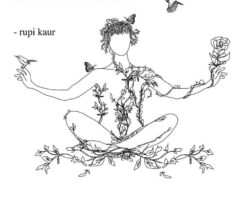 Today I came across these few words by Rupi Kaur. They reverberated with a long moment of resounding silence that welled up in recognition from my core and engulfed me. It is repeating in me still, a faint and nameless melody drifting on the strings of love. I hope it does the same for you.
I loved coming across that. It was a busy moment of my day but I let it take me right in, deep. Isn’t it amazing when the noise stops, dear one?
With love,
Mayet
** Rupi Kauar is a young Indian woman, a wonderful contemporary poet and performer, an illustrator (today’s photo is her illustration for these words), photographer and author. You might enjoy looking up her You Tube channel, she is an interesting and enjoyable artist.
A Whole New Perspective on Discipline
July 10, 2025
Article highlights:
- Have trouble disciplining yourself?
- A new look at an old chestnut
 How were you disciplined as a child? What did school teach you about discipline or your church? Discipline. After years — or lifetimes for most of us — of harsh, forced ideas about discipline as children, in monasteries and ashrams, it’s no wonder a lot of us feel wary about it, or even burned out. Perhaps its time to rethink it? Well, I came across the perfect new perspective to do that!
An author and writer I follow, MasonCurrey@substack.com has a monthly column about creativity I enjoy. In a recently blog about the creative habits of composer John Cage he cites a quote from the 2012 Cage biography by David Revill.
Mason focuses on Cage’s perspective regarding discipline, sharing that it “blew his mind” to think of discipline in this way. I have to say that I was also impacted strongly by Cage’s approach to self-discipline. My thought was, “This is the outlook on disciple that every modern spiritual seeker should adopt for their beliefs and practices!”
Naturally, then, I thought of you. I think you’ll love it as much as I (and Mason) did. To share it, let me first drop in the paragraph Mason shared by the Cage biographer and let you discover it as I did.
Revill writes: “Cage points out that discipline comes from the same root as “disciple” — one gives oneself up, administers one’s life from the core of one’s being so it may follow a path. “Discipline is giving yourself rather than expecting things to give themselves to you,” in the formulation of Cage.
“Disciplines are important as disciplines. The specific nature of the discipline is not as important as the discipline itself.” He proposes, “the question is not what should I do or how to do it but how one achieves the state of being disciplined — learning true discipline is to give oneself up.”
Then Mason Currey continues,
“OK, this kind of blew my mind. Discipline is not a virtue that some people possess and others lack, Cage says, nor is it a muscle to be exercised and strengthened over time. Rather, it is giving yourself over to something. It is not about exerting self-control; it’s about surrendering control.”
Whoa! Right? Many of us have struggled with, or shied away, or rebelled against the idea of spiritual discipline. Certainly that includes me — too many lifetimes in ashrams and monasteries perhaps. Forcing and regimenting feels more exhausting than freeing.
But giving oneself to one’s practice or commitment or to one’s spiritual path in general — well that feels like a fabulous fit to me! What a perfect upgrade of discipline for the spiritual journeyer of any kind, right?
I also love the sentence saying , “one gives oneself up, administers one’s life from the core of one’s being so it may follow a path.” Think of that… living or administering your life from the core of your being to allows your life to unfold from your core! Doesn’t that just make soOoo much sense? It does to me.
You can even apply that to daily living… to you work, to changing your diet or a habit, to exercising, or to any aspect of your day. As a “giving” not a forcing, or a “have to.” Redefining discipline in this way is a wonderful AHA for me, how about you?
With love,
~ 💗 Mayet